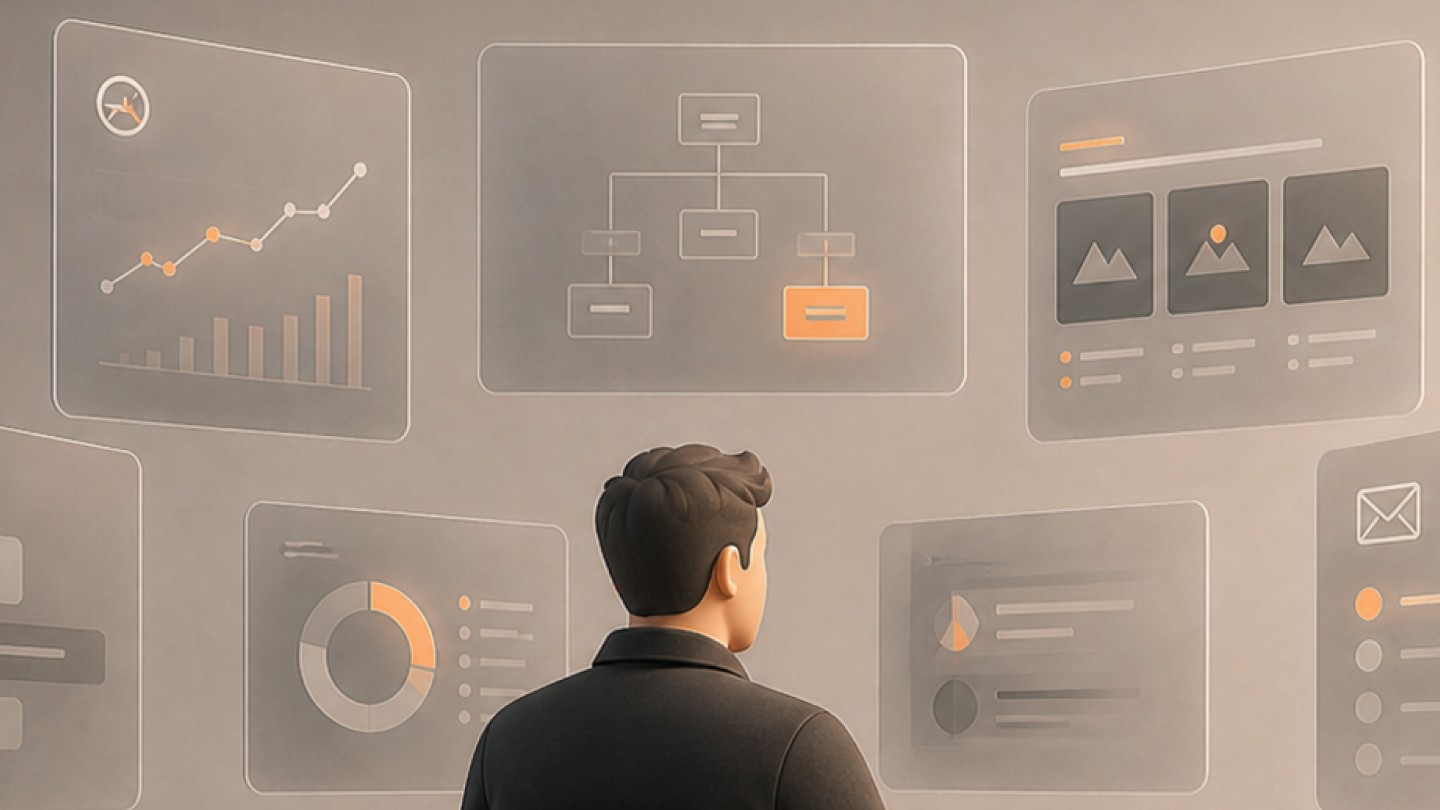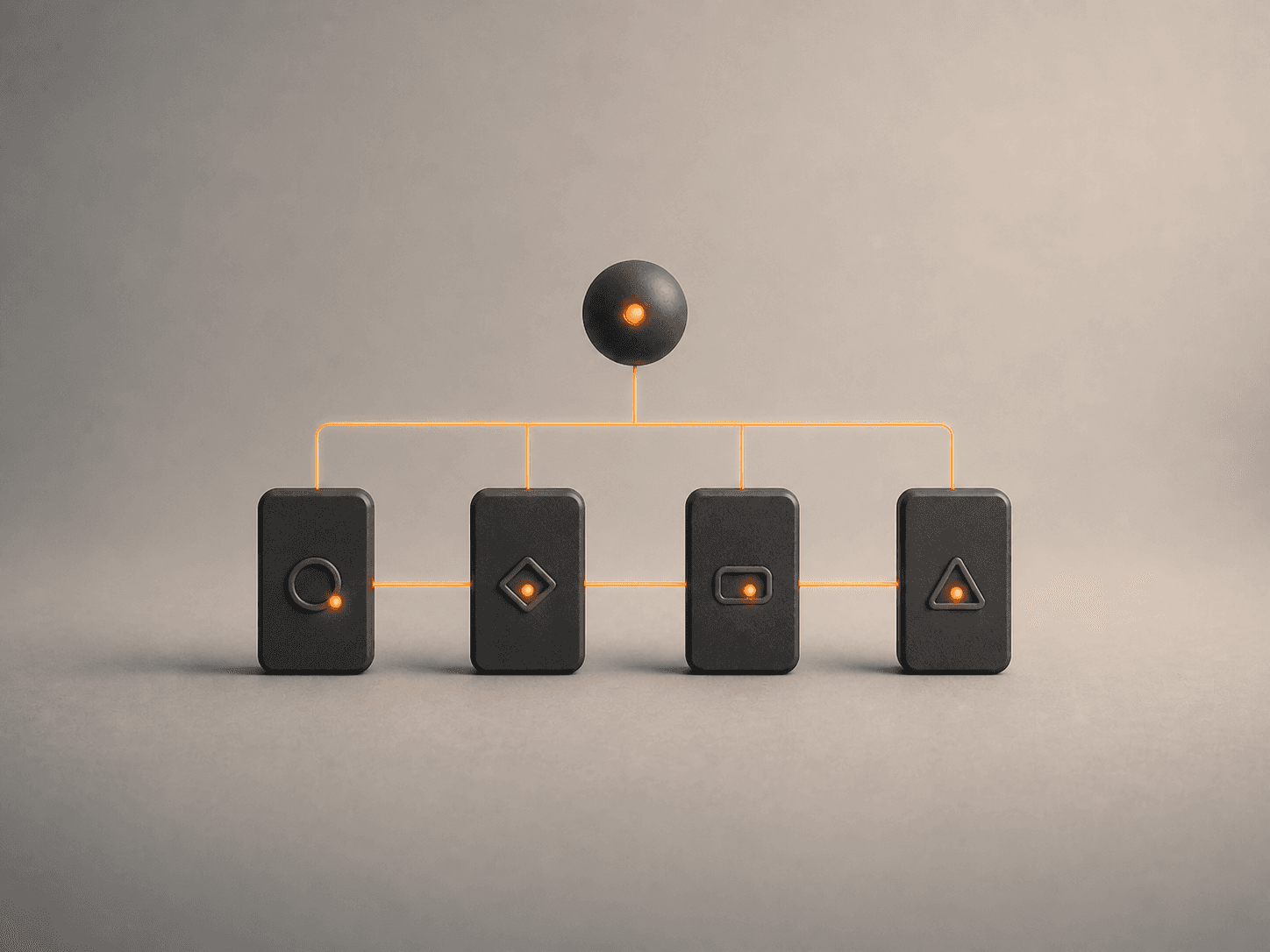
A connected agent stack shares intelligence across every funnel stage and compounds with each cycle. How the architecture works from top of funnel to lifecycle.
WRITTEN BY
Jon Kruzeniski
Growth has always been a systems problem. The best practitioners never thought in campaigns. They thought in loops, in compounding mechanisms where each stage of the customer journey fed the next. The constraint was always the same: the gap between what the data was telling you and how fast you could act on it.
That constraint is collapsing.
A viral moment that circulated across the AI industry pointed to something worth paying attention to. A single growth marketer at Anthropic was running what previously required a team spread across multiple siloed roles, using Claude Code to coordinate execution that used to demand five or ten specialists across different functions. The significance was not just the efficiency. It was that the silos themselves had become optional. The agent stack was the team.
That story landed the way it did because it named something people were already sensing but had not yet seen clearly. The structure of a growth organization, one person for paid, one for organic, one for email, one for data, one for lifecycle, was not built because that was the most effective way to drive growth. It was built because that was the only way to manage the execution load. Each specialist existed to handle the volume and complexity of their function because no single person could hold all of it simultaneously.
Agents change that equation entirely. Not because they replace the thinking, but because they absorb the execution. The strategist who understands paid acquisition, organic content, mid-funnel communication, and data interpretation no longer needs a specialist in each function to make things move. They need a system. And the system, when built properly, does not just execute faster. It connects the signals across every function in a way that siloed specialists never could, because each specialist only ever saw their own slice.
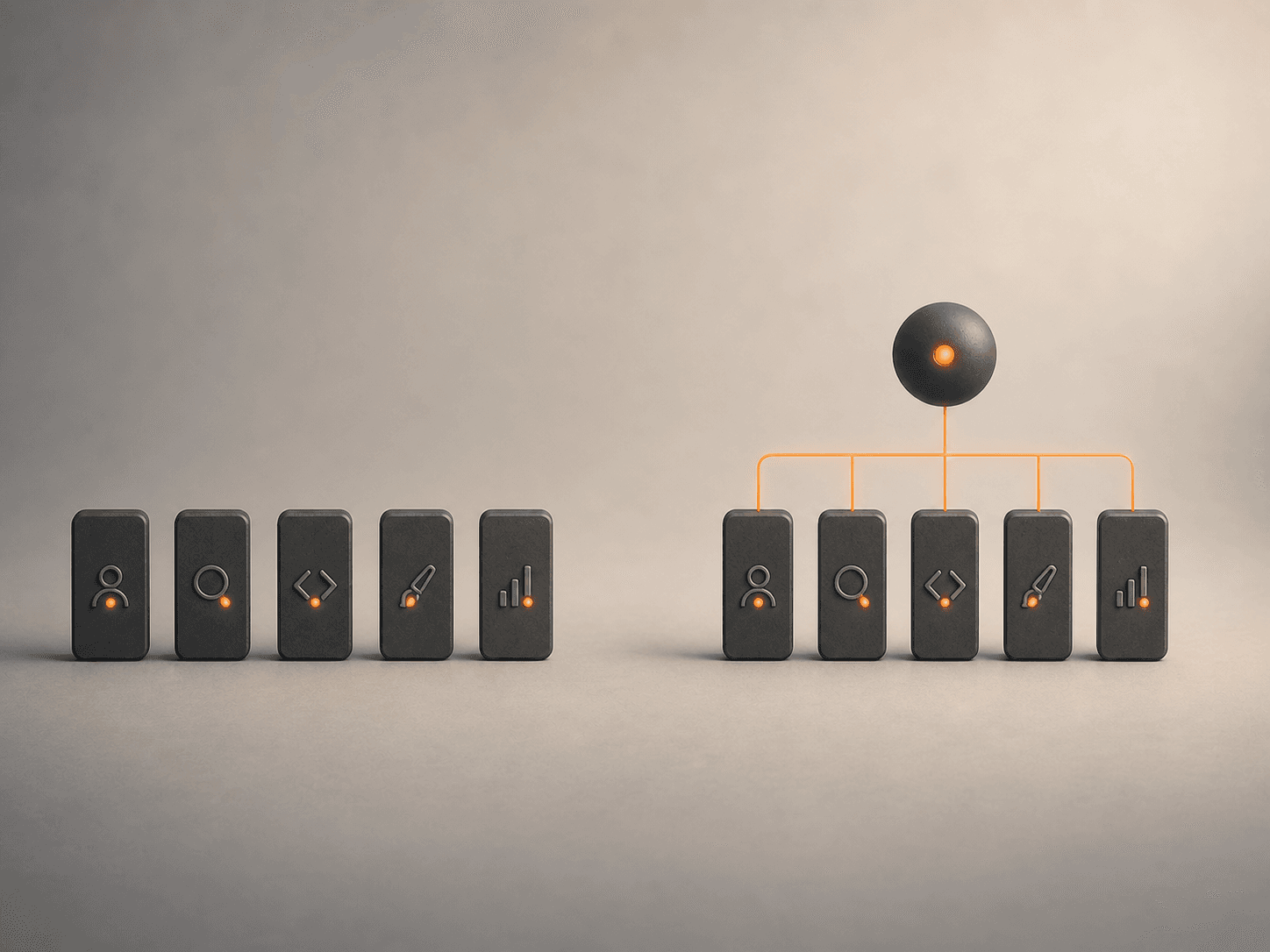
This is what is meant when people talk about go-to-market engineering as something fundamentally different from the SaaS era model. The old structure optimized for managing execution across silos. The new structure collapses the silos and optimizes for compounding intelligence across the whole system. One stage feeds output into the next. Every cycle makes the next one smarter. The growth operation becomes something closer to a single organism than a collection of departments.
That is the shift. And it is already happening.
This is what the system looks like when it is built properly.
What an Agent Actually Is
An agent is not a chatbot. It does not wait for a prompt and return an answer. It receives a goal, breaks it into tasks, executes those tasks using the tools available to it, interprets the results, and adjusts. It closes the loop.
The distinction that matters is outcomes over outputs. And the architecture that works is not one agent doing everything. It is a stack where each agent owns a defined function, shares intelligence with the others, and a layer above reads what all of them are seeing together. That shared intelligence layer is where the real compounding happens.
A prompt without the right infrastructure underneath it produces mediocre work at speed. The agent is not just the instruction set. It is the instruction set plus the data it reads, the brand and positioning context it operates within, and the quality bar set before it produces a single output. That is what separates a growth system from a faster way to generate average content.
Top of Funnel
At the top of the funnel the agent architecture is most legible. Paid creative iteration in particular benefits significantly from agents that generate, deploy, monitor, and iterate continuously. The creative iteration loop that used to take weeks, brief to asset to launch to data to insight to brief again, can now close in hours for a team with the right architecture in place.
What makes this genuinely different is not speed alone. It is that the system learns. Each iteration is informed by what the previous one taught. Over a quarter that compounding is not marginal. It is structural.
Organic content operates on a different cadence but the same principle applies. An agent that maintains brand voice at scale, monitors engagement signals continuously, and adapts based on what is resonating in real time is doing something no human content team can match for consistency over time. And because organic engagement signals, shares, branded search volume, direct traffic, tend to move before revenue does, the organic agent is not just managing a content calendar. It is reading early indicators of what the business is about to do.
Mid and Bottom Funnel
This is where the architecture gets more considered.
Mid-funnel is not one problem. It is a communication and content layer that spans email workflows, nurture sequences, SMS, case studies, pricing signals, and more, each with its own logic and its own timing. The agent architecture here reflects that complexity. Content agents, communication agents, and data agents work in concert, each purpose-built, none interchangeable.
The further down the funnel you go the more custom the build. Pricing intelligence surfaces differently than nurture logic. Bottom-of-funnel interventions require a different kind of precision than top-of-funnel iteration. The system has to be designed to hold that nuance, not flatten it.
What stays constant across all of it is the underlying principle. Behavioral signals inform the workflow. The workflow adapts dynamically. A system that reads where each person actually is and responds accordingly.
Lifecycle
Post-conversion is where the compounding economics of growth become most visible. Acquiring a customer costs significantly more than retaining one. Lifetime value is built here, not at the top of the funnel.
The lifecycle layer is also where the agent architecture requires the deepest integrations. Purchase history, engagement signals, churn indicators, renewal timing, these all live across systems that need to talk to each other before an agent can act intelligently on any of them. The build here is more considered than anything above it, and that investment reflects what is at stake.
An agent that identifies churn risk before it becomes a cancellation, that manages the post-purchase relationship in a way that makes customers feel genuinely served, and that surfaces the conditions for expansion revenue is not a nice to have. It is where the growth flywheel either closes or leaks.
The Intelligence Layer
Above every funnel-specific agent sits the layer that makes the whole system more than the sum of its parts.
The data interpretation agent reads across everything. It surfaces the connections that no individual agent operating in isolation would catch. Which acquisition angle predicts stronger retention downstream. Which content type correlates with faster conversion. Which pricing signal indicates intent versus hesitation. Observations that would take a human analyst days to surface are flagged in real time, fast enough to act on before the window closes.
This is what was meant when a prominent voice in the space observed that the biggest untapped lever in most growth operations is not more data. It is closing the gap between the data and the decision. The intelligence layer is how that gap closes permanently.

What This Means
The teams pulling ahead are not the ones with the biggest budgets or the most specialists. They are the ones who have stopped thinking in campaigns and started building infrastructure that compounds.
A strategist with a well-constructed agent stack can now orchestrate what used to require a department, not by working harder, but because the agents handle execution, iteration, and interpretation continuously. The human role shifts toward the work that actually requires judgment: strategy, positioning, creative direction, and knowing when the system needs to be recalibrated.
The old growth model was built around people managing execution across silos. The new one is built around systems that share intelligence across the entire funnel. The difference is not incremental. A siloed team generates data within each function and rarely connects it across them. A connected agent stack generates data across every stage simultaneously and learns from all of it together. That compounding intelligence is what makes the gap between early movers and late adopters widen over time rather than close.
The funnel is not a series of stages to manage. It is a system to build. And the system that shares intelligence across every stage, learns from every cycle, and gets measurably smarter over time is not a future concept.
It is what we build.